Tuesday, December 13, 2005
Density wave
最簡單的說法就是塞車,汽車塞車也是一個波。高速公路上有很多條線道,有時候遇到車禍或是工程維修時,車道就變少了,從寬道變成窄道時,就會產生塞車。塞住的地方,車子的密度就比較高,可以看做密度波的波峰。不過波的速度和車的速度是兩回事。車子一輛接著一輛往前開,但修路的路段可能今天在這裡,明天在另一個地方,兩個速度是不一樣的。如果你每天固定照相,就可以從照片中看出密度波行進的速度了。車子就好比星系裡的星球,而塞車的地方就是密度波經過的地方。
問:那麼,密度波的概念在星系形成上有何重要性呢?
答:星系為什麼產生這種結構,在科學上是個很令人好奇的問題,連費曼都感興趣。天文和物理不太一樣,量子力學也是一個波的理論,它有穿透、有反射,但是不會有超反射(over reflection),因為機率密度都是正的,不會有負的;天文不一樣,在天文上有重力影響。密度波的重要性,不只可以解釋星系形成,在宇宙間還有很多應用。例如土星和海王星都有環,這些環有的很細,就是一種密度波的>應用,重力把環維持在很細的狀態,一方面不讓物質掉出環外,一方面也不讓物質掉進環內,一般都認為重力是互相吸引,但是在轉的時候卻有可能是互相推開的。此外,太陽系為什麼產生行星,也可以>用密度波來解釋;而星系比土星的環大了一兆倍,還是照樣可以套用這理論。
問:除了大學時跟著林家翹教授做密度波外,您對密度波還有更深入的研究嗎?
答:大學時研究的是恆星的分佈和形狀的關係,寫完論文後,我對天文產生了興趣,就跟著林教授一起往天文物理做下去。第二個研究,走到更高層次,是和密度波的振幅有關,也就是我的博士論文。因為不同的振幅有不同的光譜,林家翹教授建議我去計算密度波的振幅,這個也很難算,最後算了60多頁,消去很多項才算出最後的式子。但這個想法是圖莫(Alar Toomre)提出來的,它和能量的密度、能量守恆及角動量守恆有關。
這個研究最有趣的地方,我說出來相信你們會欣賞,就是能量和角動量的密度有一個圈,叫做共同旋轉圈(co-rotation),在圈上星球和密度波的角速度是一樣的,在這個圈內的星球走得比較快,密度波的能量是負的;在圈外的星球走得比較慢,密度波能量是正的。隨著星系繞轉,在圈內的能量越加越負,在圈外的則是越加越正,而整個系統的能量永遠是零。看起來很多東西,但是加起來卻是零,這就如同宇宙現在的情況非常有趣。沒有違背守恆的定律(conservation law),卻可以觀測到其中的東西。
 The original:
The original:
- http://nedwww.ipac.caltech.edu/level5/Rings/frames.html
- http://nedwww.ipac.caltech.edu/level5/Rings/paper.pdf Pdf-version
- http://www.phys.ncku.edu.tw/~astrolab/e_book/galaxies/galaxies.html
The structure of this review is as follows:
- First, we provide a historical review to help place the subject into a proper context, and to define the basic characteristics of the main ring types.
- Next, we present a thorough discussion of more recent observations of ringed galaxies from a variety of approaches: morphological, photometric, kinematic, and statistical. Then we discuss rings as resonances in barred galaxies, the role of gravitational torques on their formation, the influence of periodic orbits, and the use of N-body and test-particle simulations.
- After this, we consider the special problem of rings in nonbarred galaxies and how they might be related to spiral modes and resonances, and the possible dissolution of bars. Next, we will consider ring formation via mild tidal encounters as opposed to the more violent encounters that are believed to cause the polar ring galaxies and collisional ring galaxies. (These latter ring types are reviewed by Appleton and Struck-Marcell 1996.)
- Finally, we will discuss a few of the unusual examples which, though obviously barred, do not readily fit into the theoretical framework which we outline.
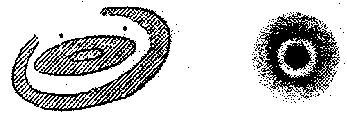
Figure 2. Visual detection of inner rings in NGC 4725 (left, drawing by R. J. Mitchell in 1858; see Parsons 1926) and NGC 4736 (right, drawing by Lassell 1866).
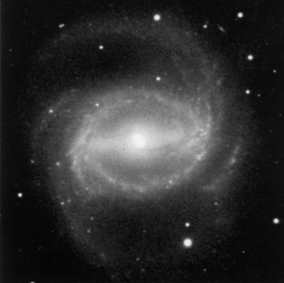
Figure 3. B-band CCD image of NGC 1433, a ``phi-type spiral'' with a bright inner ring. NGC 1433
|
| Visual detection of inner rings in NGC 4725 (left, drawing by R. J. Mitchell in 1858; see Parsons 1926) and NGC 4736 (right, drawing by Lassell 1866). |
# posted by samuel @ 8:17 PM 
